Company & history
Product, positioning, available company details, domain registration and earliest observed web activity. Registration and company founding are treated as different dates.
ASTRACIA INTELLIGENCE / MARKET RESEARCH
Bring competitors, potential candidates, website structures, pricing, search signals and distribution channels into one research workspace. Connect the evidence to market gaps, partners and a practical plan for your startup.
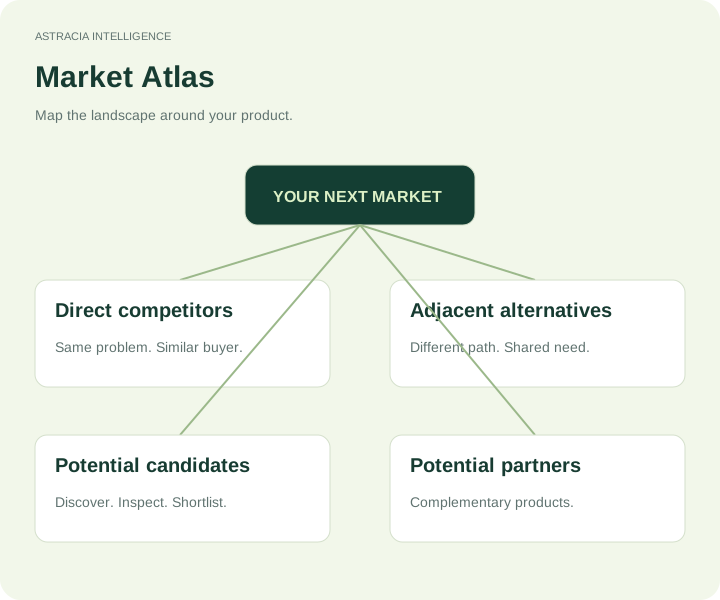
ASTRACIA INTELLIGENCE / REAL APPLICATION SCREENS
One original research project, shown across its connected views. Open the example to inspect the recorded findings and the complete available report.
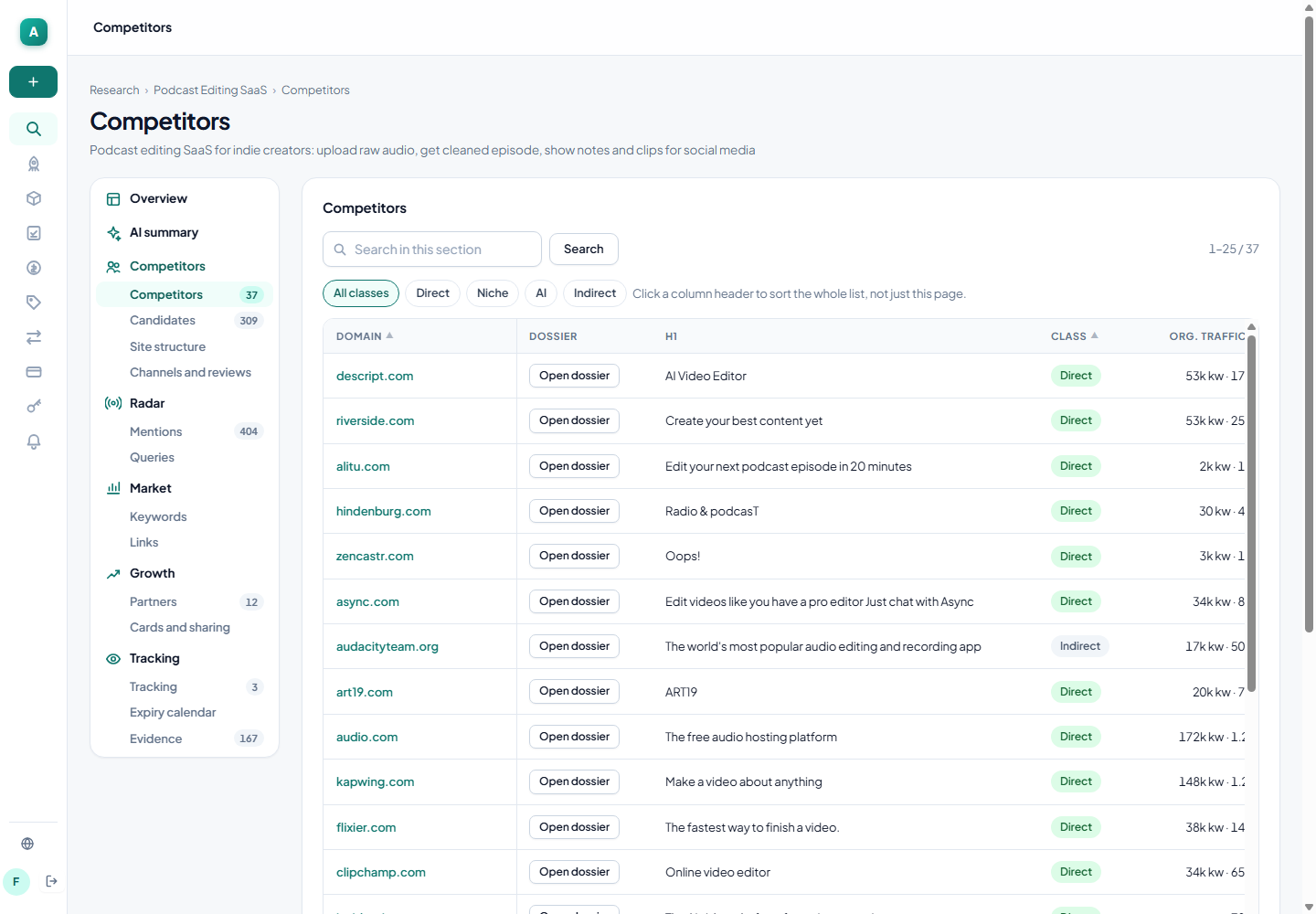
Market Atlas — Compare the companies discovered in the research.
Open full size ↗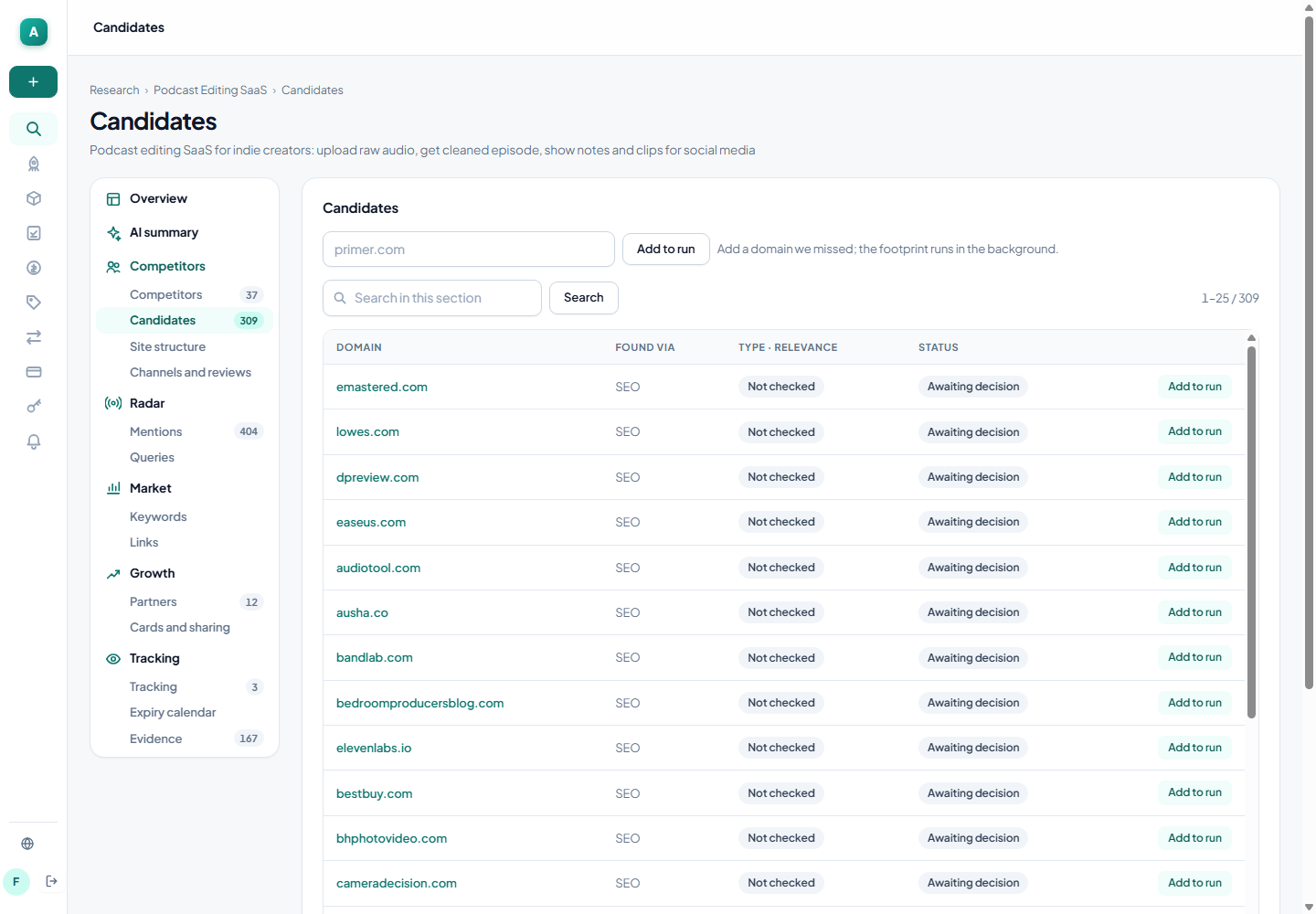
Candidates — Inspect the wider discovery list and its relevance.
Open full size ↗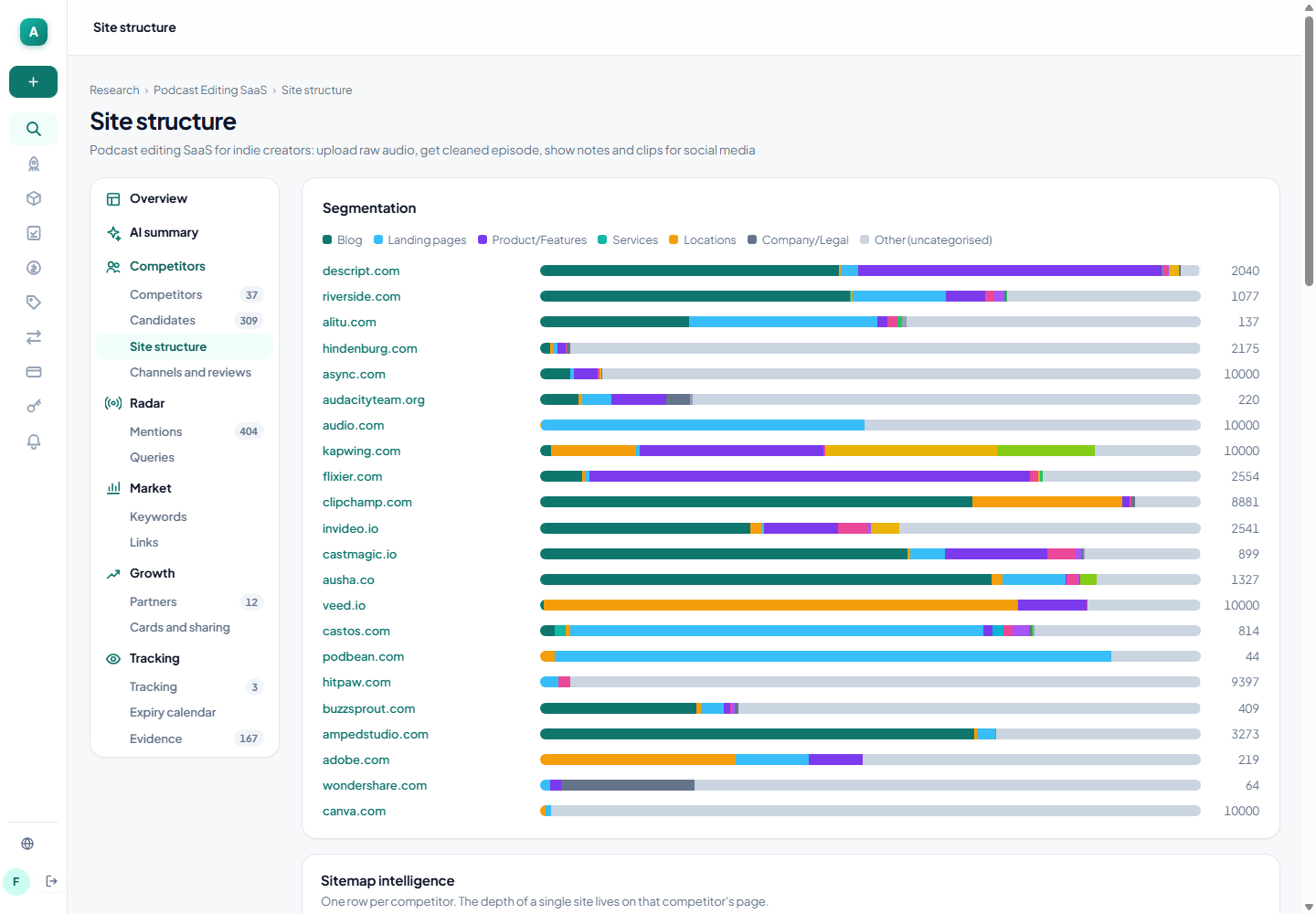
Website DNA — Compare how competitor websites are structured.
Open full size ↗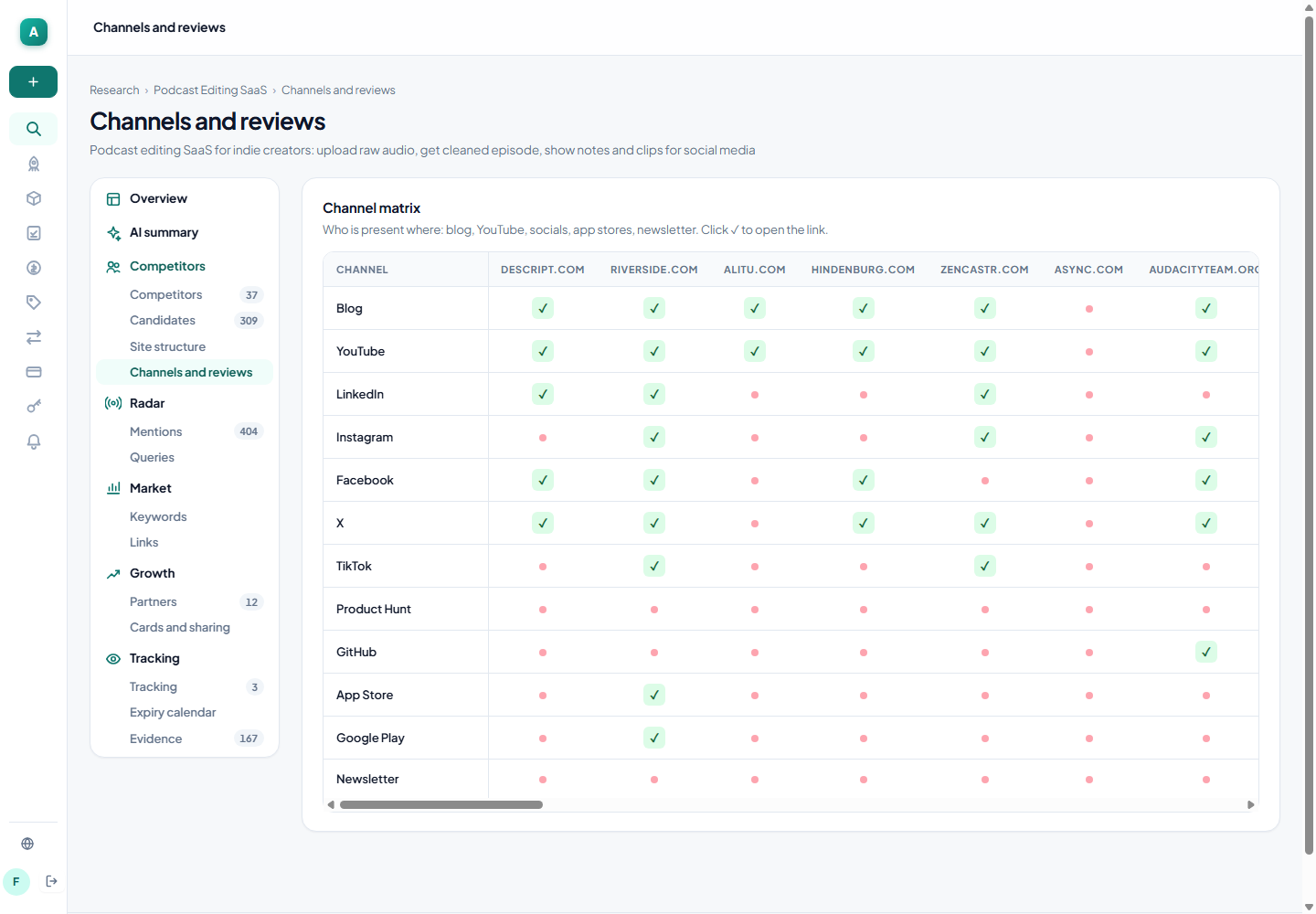
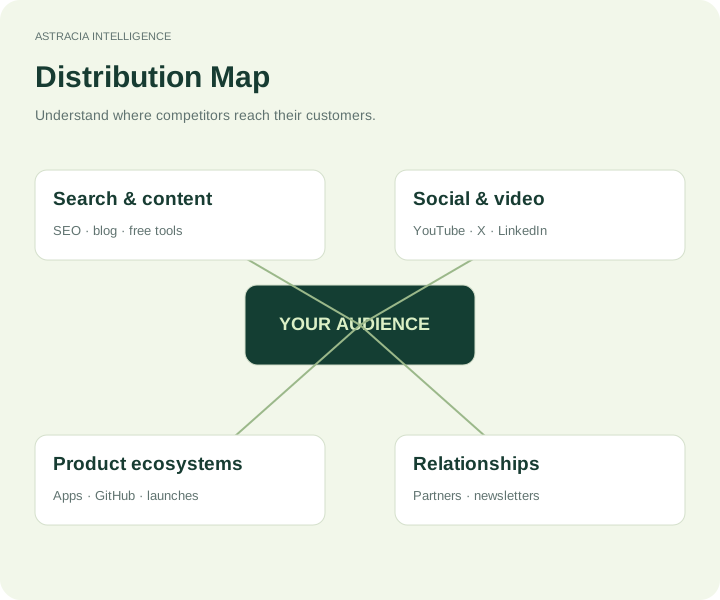
Distribution Map — See which public channels were discovered for each company.
Open full size ↗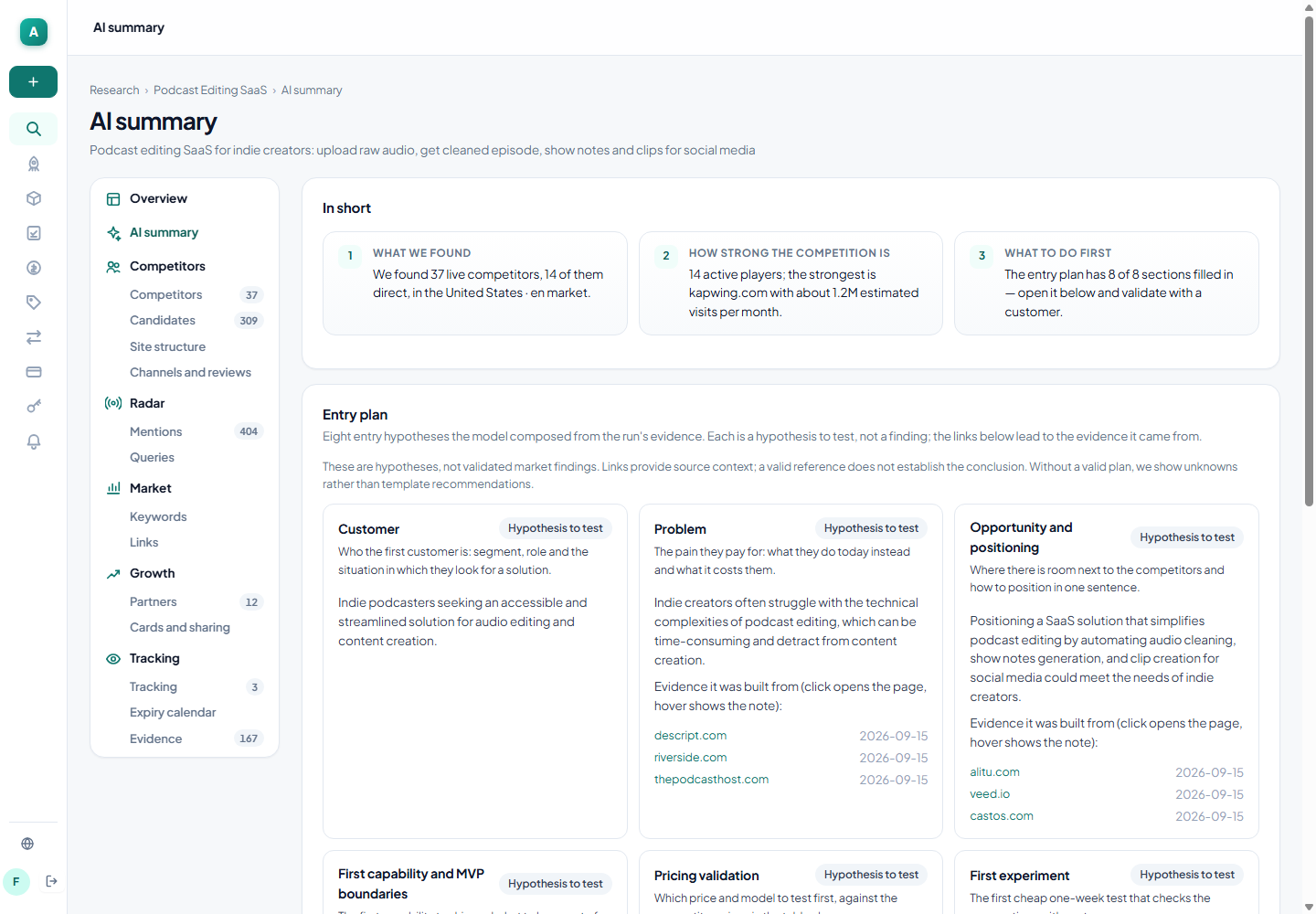
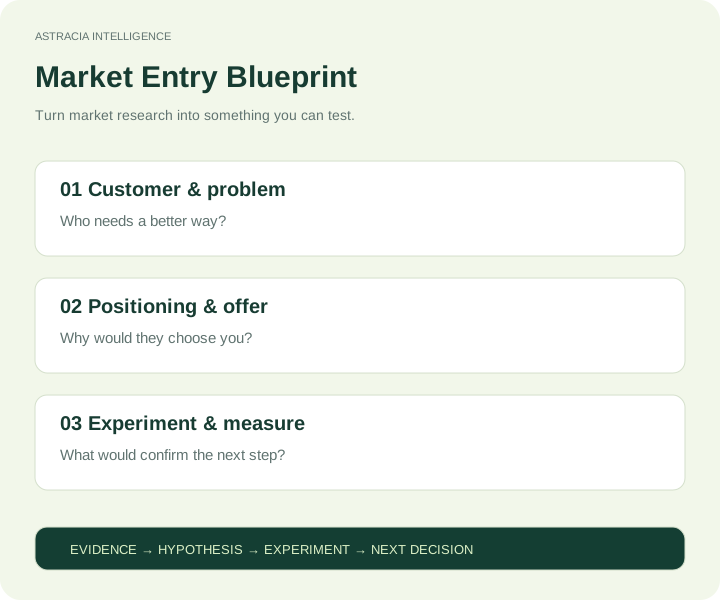
Market Entry Blueprint — Read the customer, positioning and experiment hypotheses.
Open full size ↗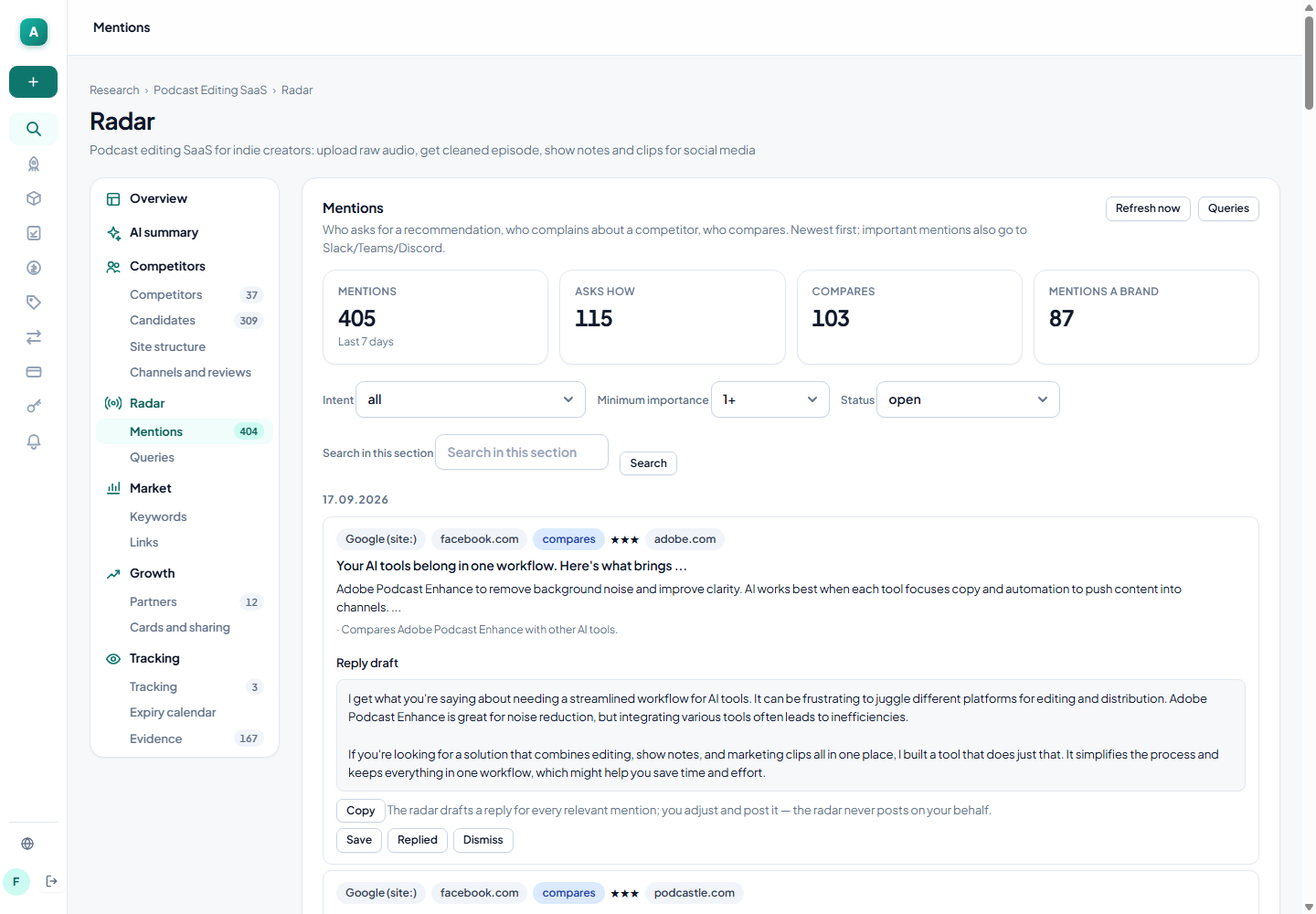
Astra Radar — Follow a relevant mention and inspect its reply draft.
Open full size ↗A recorded Light run: 37 competitors, including 14 direct competitors. Keywords and backlinks were not measured.
Open the full research example ↗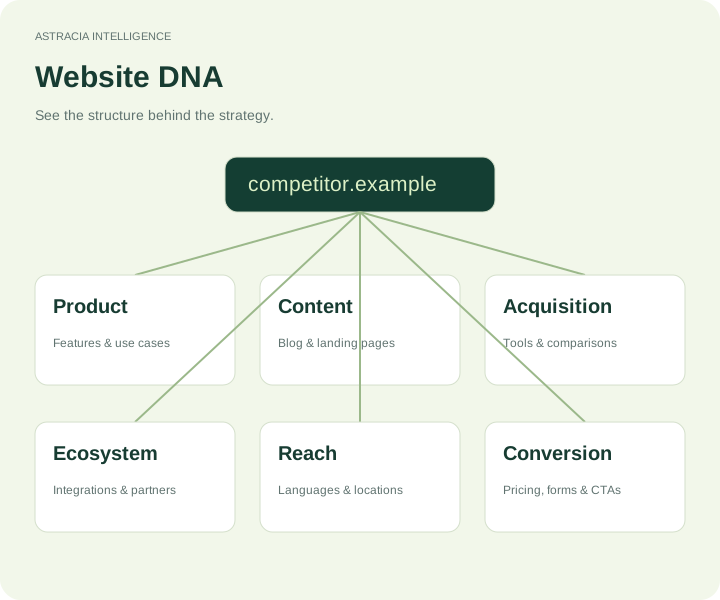
01 / MARKET ATLAS / COMPETITORS & CANDIDATES
Start with a website, an idea or a market. Research discovers relevant businesses, then separates direct competitors from adjacent alternatives and candidates that need a closer look.
02 / THE COMPANY DOSSIER
Bring company context, acquisition signals and the product offer together. Open source pages to examine the details that inform each finding.
Product, positioning, available company details, domain registration and earliest observed web activity. Registration and company founding are treated as different dates.
Available traffic estimates, organic keywords, rankings and changes over time. Estimates include source context; they are not the company’s private analytics.
Plans, public prices, billing periods, trials, free tiers, payment signals and the source pricing pages.
Products, services, landing pages, blogs, navigation, page sections, CTAs, forms, visible technology and acquisition paths.
SEO structure, local pages, schema and signals relevant to AEO and GEO. Identify programmatic patterns, comparison pages, alternatives and “vs” content.
Integration pages, affiliate programs, public partners, referring domains and potential collaboration opportunities.
03 / WEBSITE DNA
Compare the structure of competing websites, then open a company to inspect discovered URLs, page categories and the underlying sources.
GO FROM PATTERNS TO PAGES
See how a site organizes products, content and conversion. Review visible page templates, section patterns, navigation and calls to action alongside the original URLs.
Discovered URLs and checked active pages are different measures. Page classifications and SEO, GEO or AEO signals help you investigate a site’s strategy.
04 / DISTRIBUTION MAP
Build a channel picture for each competitor: the public profiles and links we discover, the content signals available and the role each channel could play in acquisition.
05 / KEYWORDS, LINKS & MARKET GAPS
Connect search themes, site coverage and backlinks to opportunities worth testing. Identify topics that are underserved, channels with potential and companies that could become partners.
07 / MARKET ENTRY BLUEPRINT
Turn findings into positioning choices, distribution experiments and a prioritized plan. Monitor selected competitors and signals so you can revisit decisions as the market changes.
START WITH YOUR CONTEXT
Describe what you are building and who it is for. Continue in the app to review the scope and start your research.
06 / ASTRA RADAR
Your market is talking.
Be ready to join.
Automatically check connected sources for your brand, competitors and keywords. Find who is mentioning you, understand the context and prepare a response that helps.
- Find the mentionFollow the original source, available author and conversation.
- Understand the intentIdentify recommendations, questions, comparisons and unmet needs.
- Prepare a replyReview a contextual draft, edit it and post on the original platform.
Explore Astra Radar and source coverage ↗“How do you find the right competitors before entering a new market?”
Start with the customer problem and compare who each product serves. A broad list is useful for discovery; a smaller shortlist helps you inspect pricing, distribution and positioning in depth.
Review the source and edit before posting.